Introduction
The ongoing conflict between Iran and Israel has become one of the most significant geopolitical crises in recent times. Over the past few weeks, military tensions in the Middle East have escalated rapidly, with missile strikes, air raids, and rising political pressure shaping the course of the conflict.
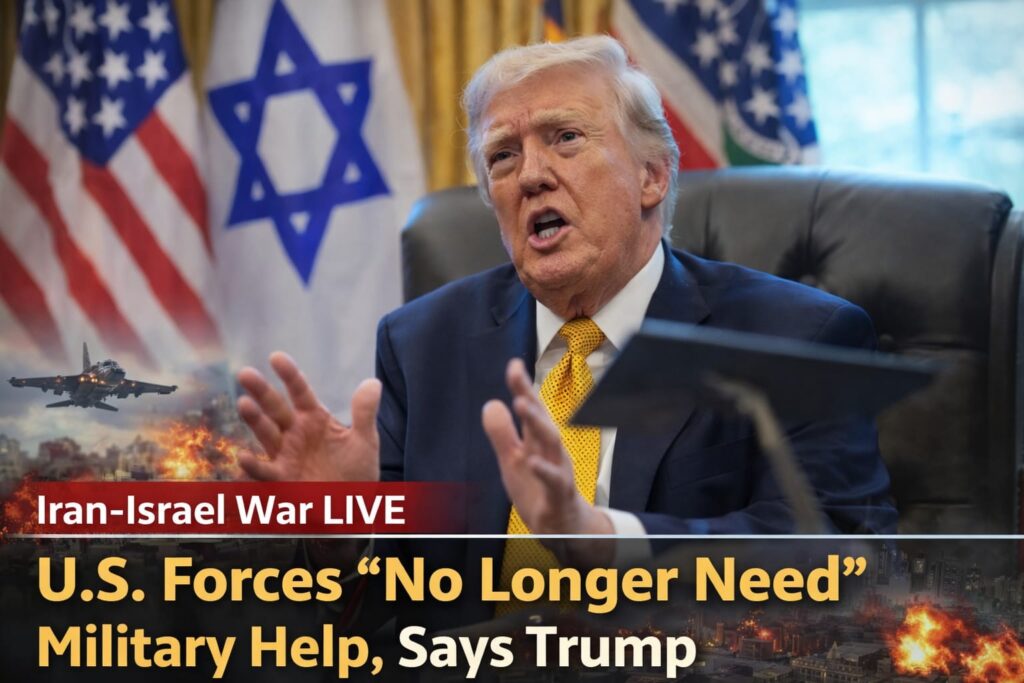
The United States has been actively supporting Israel during the conflict, launching several military operations targeting Iranian military sites. Recently, U.S. President Donald Trump made a strong statement saying that American forces no longer require military assistance from other countries in the ongoing war against Iran.
This statement has sparked widespread debate among global leaders, analysts, and defense experts about the future direction of the conflict and the possibility of further escalation in the region.
Background of the Iran–Israel Conflict
Tensions between Iran and Israel have existed for decades, largely due to political, ideological, and security differences. Israel has repeatedly expressed concerns about Iran’s missile development and nuclear ambitions, while Iran has criticized Israel’s regional influence and military actions.
The latest phase of the conflict intensified after a series of airstrikes targeted Iranian military infrastructure. These attacks reportedly focused on missile launch facilities, strategic bases, and military communication centers.
In response, Iran launched several retaliatory attacks using missiles and drones targeting Israeli positions and military bases associated with U.S. forces in the Middle East. These developments significantly increased tensions across the region and triggered fears of a wider war.
Trump’s Statement on Military Support
During a recent press briefing, President Donald Trump addressed the issue of international military support. Several allied countries reportedly declined to participate directly in the conflict, preferring diplomatic solutions instead of military involvement.
Trump reacted strongly to this decision and stated that the United States possesses enough military capability to continue operations without additional support.
According to Trump, the U.S. military remains one of the most powerful forces in the world and can manage the situation independently if necessary.
His statement that “we do not need military help” reflects confidence in the strength of American armed forces but also highlights growing disagreements among Western allies regarding the conflict.
Military Developments in the Region
Recent reports indicate that Israeli and U.S. forces have carried out coordinated operations targeting key Iranian military assets. Airstrikes have reportedly destroyed multiple missile launch sites and weapons storage facilities.
Military analysts believe that these operations have weakened Iran’s ability to launch large-scale missile attacks in the short term.
However, Iran continues to demonstrate its capability to retaliate through drone attacks and long-range missile systems. Some of these attacks have targeted strategic areas and military installations linked to Israel and U.S. forces.
As both sides continue military operations, the conflict remains highly unpredictable.
Concerns About a Wider Regional War
One of the biggest concerns surrounding the Iran–Israel conflict is the possibility of it expanding into a broader regional war. Several Middle Eastern countries are closely monitoring the situation because further escalation could destabilize the entire region.
The Middle East already faces complex political and security challenges. If additional countries become directly involved in the conflict, the situation could quickly become more dangerous.
International organizations and diplomats have repeatedly called for restraint and dialogue in order to prevent the conflict from spreading further.
Impact on Global Economy and Oil Markets
Beyond the battlefield, the Iran–Israel conflict is also affecting the global economy. One of the most important concerns is the potential disruption of oil transportation routes in the Persian Gulf.
The region contains some of the world’s most critical energy shipping lanes. Any disruption to these routes could cause fluctuations in global oil prices and impact fuel costs in many countries.
Investors and financial markets are closely watching developments in the Middle East because prolonged instability could affect global trade, energy supply, and economic growth.
Political Reactions Around the World
Global reactions to the conflict have been mixed. Some countries have expressed support for Israel and the United States, emphasizing the importance of regional security.
Other nations have called for an immediate ceasefire and diplomatic negotiations to reduce tensions.
International leaders are concerned that continued military action could create humanitarian issues and further instability in the region.
As a result, diplomatic efforts are ongoing behind the scenes to explore possible solutions that could reduce the intensity of the conflict.
What Could Happen Next?
Experts believe the situation could develop in several ways depending on military and political decisions in the coming weeks.
Possible scenarios include:
Continued airstrikes and military exchanges between Iran and Israel
Increased involvement of international allies
Diplomatic negotiations aimed at reducing tensions
Temporary ceasefire agreements to prevent further escalation
The direction of the conflict will largely depend on how both sides respond to ongoing military pressure and international diplomatic efforts.
Conclusion
The Iran–Israel war has become a critical issue in global politics, drawing attention from governments, security experts, and international organizations.
President Trump’s statement that the United States does not require additional military assistance has added a new dimension to the debate surrounding the conflict.
While military operations continue, the possibility of escalation remains a serious concern. The coming weeks will be crucial in determining whether the situation moves toward further confrontation or diplomatic resolution.
For now, the world continues to monitor the developments closely as tensions in the Middle East remain high.
Iran–Israel War LIVE: U.S. Forces ‘No Longer Need’ Military Help in the Iran War, Says Trump