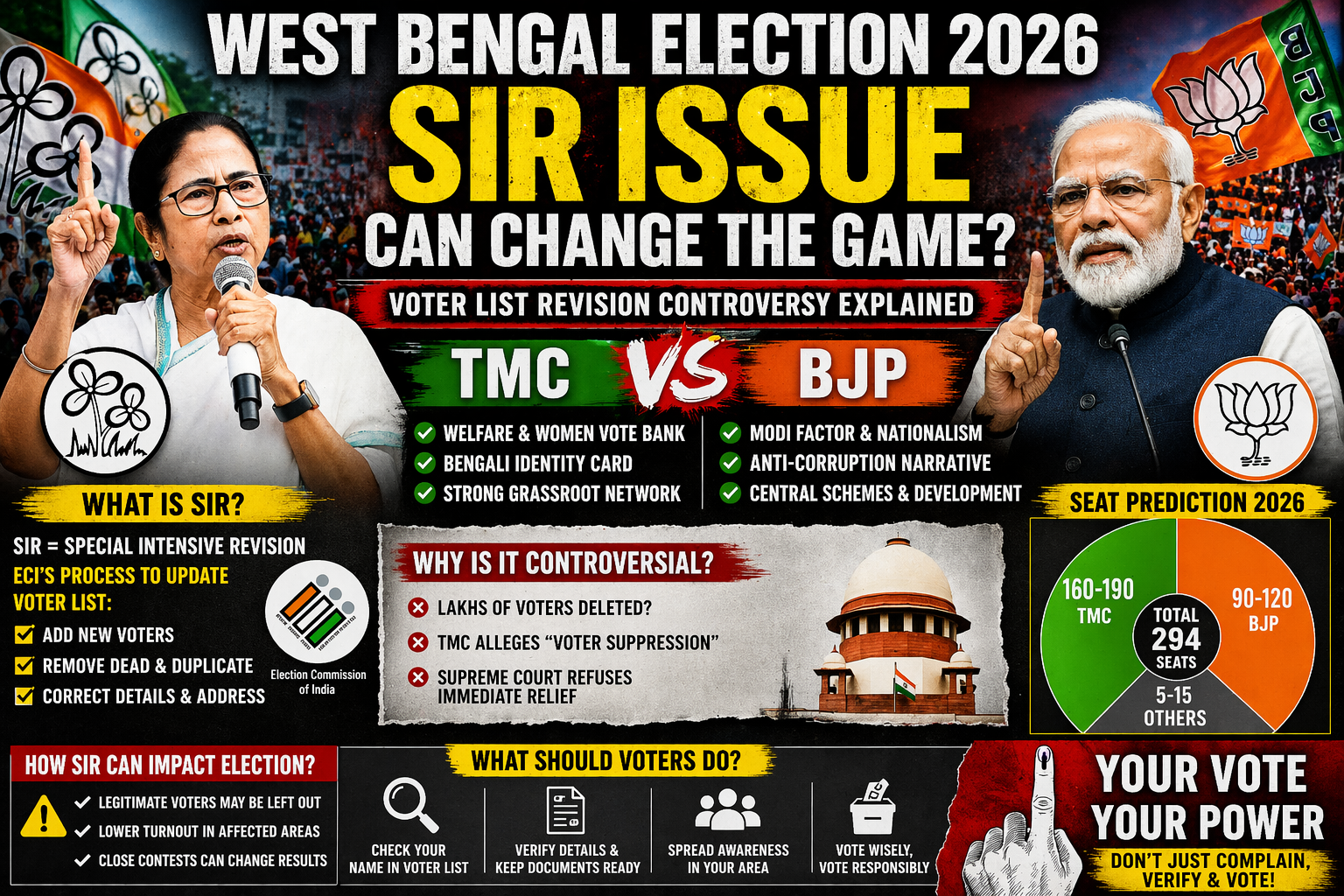
West Bengal Election 2026 SIR Issue infographic
Spread the love

West Bengal Election 2026 is shaping up to be one of the most important political battles in recent years.

Introduction:   A State at a Political Crossroads
West Bengal has always held a unique position in India’s political landscape. From the long rule of the Left Front to the rise of regional powerhouses, the state has seen ideological shifts that reflect both local aspirations and national trends. As the 2026 Assembly Election approaches, the contest between All India Trinamool Congress (TMC) and Bharatiya Janata Party (BJP) has intensified, shaping not only electoral outcomes but also the broader discourse on governance, development, and identity.
At the center of this political battle stands Mamata Banerjee, a leader who has dominated Bengal politics for over a decade, and Narendra Modi, whose party is determined to expand its footprint in eastern India.
This article explores the evolving strategies of both parties, analyzes their strengths and weaknesses, predicts possible seat outcomes, and reflects on what these developments mean for governance and the everyday citizen.
Historical Context: From Left Dominance to Bipolar Politics
To understand the current dynamics, one must revisit Bengal’s political evolution. For over three decades, the Left Front, led by the Communist Party of India (Marxist), governed the state with a focus on land reforms and grassroots organization. However, by the late 2000s, dissatisfaction over industrial stagnation and governance fatigue created space for change.
That change came in 2011, when Mamata Banerjee’s TMC ended Left rule with a massive mandate. Since then, TMC has remained the dominant force, winning subsequent elections in 2016 and 2021.
However, the rise of BJP in Bengal marks a significant shift. From being a marginal player, BJP emerged as the principal opposition, especially after its strong performance in the 2019 Lok Sabha elections and the 2021 Assembly elections.
Today, Bengal’s politics has transformed into a largely bipolar contest between TMC and BJP.
The Current Political Landscape (2026)
As of 2026, several key factors define the political climate in West Bengal:
Strong incumbency vs anti-incumbency tension
Corruption allegations vs welfare delivery
Regional identity vs national integration narrative
Grassroots dominance vs centralized campaign strategy
The electorate is no longer voting along traditional ideological lines. Instead, issues such as employment, governance efficiency, and economic opportunities have become central.
TMC’s Strategy: Welfare, Identity, and Ground Control
1. Welfare-Centric Governance
TMC’s most powerful tool has been its welfare schemes. Programs like Lakshmir Bhandar, Kanyashree, and Sabooj Sathi have created a strong support base, especially among women and rural populations.
These schemes are not just policy initiatives; they are political instruments that ensure direct engagement with beneficiaries. In many households, the state government is seen as a provider of stability and financial support.
2. Bengali Identity Politics
TMC has consistently framed itself as the protector of Bengali culture and pride. The narrative often contrasts “outsider politics” with “insider representation,” appealing to regional sentiments.
This strategy has proven effective in countering BJP’s nationalistic messaging by localizing the political discourse.
3. Organizational Strength at the Grassroots
Perhaps TMC’s biggest advantage lies in its organizational network. From panchayats to urban municipalities, the party maintains a strong presence that ensures voter mobilization and election management.
4. Leadership Factor
Mamata Banerjee’s personal image as a grassroots leader continues to resonate with many voters. Her direct communication style and accessibility reinforce her connection with the masses.
Weaknesses of TMC
Despite its strengths, TMC faces several challenges:
Corruption Allegations: Scandals related to recruitment and financial irregularities have dented its image.
Anti-Incumbency: After more than a decade in power, voter fatigue is inevitable.
Internal Factionalism: Local-level conflicts sometimes weaken organizational unity.
BJP’s Strategy: Change, Nationalism, and Central Leverage
1. Anti-Corruption Narrative
BJP’s primary attack line against TMC revolves around corruption. By highlighting alleged scams and governance failures, the party aims to position itself as a cleaner alternative.
2. National Leadership Appeal
The popularity of Narendra Modi plays a crucial role in BJP’s campaign. His image as a strong and decisive leader is leveraged to attract voters seeking change.
3. Religious and Cultural Mobilization
BJP has attempted to consolidate Hindu votes by emphasizing religious identity and cultural issues. While this strategy has yielded results in some regions, it remains uneven across the state.
4. Central Government Schemes
BJP frequently highlights central schemes such as housing, sanitation, and LPG distribution, arguing that better alignment between state and center would accelerate development.
Weaknesses of BJP
Limited Local Leadership: The absence of a strong, widely accepted state leader remains a major gap.
Cultural Disconnect: In some areas, BJP struggles to connect with Bengal’s unique socio-cultural identity.
Organizational Gaps: Compared to TMC, BJP’s grassroots network is still developing.
Seat Prediction for 2026 Assembly Election
Predicting election outcomes is inherently uncertain, but based on current trends, voter behavior, and organizational strength, a realistic scenario can be outlined.
Total Seats: 294
Projected Distribution:
TMC: 160–190 seats
BJP: 90–120 seats
Others (Left, Congress, Independents): 5–15 seats
Scenario Analysis
Scenario 1: TMC Retains Power (Most Likely)
If TMC successfully mobilizes its welfare beneficiaries and counters anti-incumbency, it is likely to secure a comfortable majority.
Scenario 2: Tight Contest
If BJP manages to expand its rural base and capitalize on corruption issues, the gap could narrow significantly, leading to a more competitive assembly.
Scenario 3: Surprise Upset (Low Probability)
A complete shift in voter sentiment, combined with strong BJP organization, could lead to an upset—but current indicators suggest this is unlikely.
Development Debate: Who Can Deliver Better Governance?
If TMC Wins
Continued focus on welfare schemes
Stability in governance
Incremental development rather than rapid industrial expansion
However, concerns remain about investment climate and job creation.
If BJP Wins
Potential boost in infrastructure and industrial projects
Better coordination with the central government
Policy shifts toward economic reforms
But risks include reduced emphasis on localized welfare programs.
Reality Check
Development is not solely dependent on which party wins. It depends on:
Policy execution
Administrative efficiency
Transparency and accountability
Both parties have the capacity to deliver—but only if governance is prioritized over politics.
TMC vs BJP: Power vs Weakness (Comparative Analysis)
Factor
TMC
BJP
Leadership
Strong, centralized
Strong national, weak local
Organization
Deep grassroots network
Expanding but uneven
Core Strategy
Welfare + identity
Change + nationalism
Strength
Women vote bank, rural reach
Central support, Modi factor
Weakness
Corruption allegations
Cultural disconnect
Growth Potential
Limited (already dominant)
High (expanding base)  The Role of Voters: What Should Common People Do?
In a democracy, the ultimate power lies with the people. However, voting is not just a right—it is a responsibility.
1. Avoid Blind Loyalty
Political allegiance should not be based on emotion, religion, or identity alone. Performance and accountability must be the primary criteria.
2. Evaluate Local Candidates
Often, local representatives have a greater impact on daily life than national leaders. Voters should assess their track record.
3. Focus on Core Issues
Employment, education, healthcare, and infrastructure should guide voting decisions.
4. Resist Misinformation
In the age of social media, fake news can distort reality. Critical thinking is essential.
5. Demand Accountability
Citizens must actively question leaders and demand transparency.
Conclusion: The Future of Bengal Lies in Balanced Politics
The 2026 West Bengal Assembly Election is more than a contest between two parties. It is a test of governance models, political narratives, and public expectations.
TMC represents continuity, welfare, and regional identity. BJP represents change, national integration, and centralized development.
Neither model is perfect. Each has strengths and limitations. Ultimately, the direction Bengal takes will depend not just on political strategies, but on the awareness and choices of its people.
The state stands at a crucial juncture. The decisions made in this election will shape its economic trajectory, social fabric, and political culture for years to come.
In the end, democracy is not about who wins—it is about how responsibly power is exercised and how effectively it serves the people.

SIR voter list issue”

Election Commission of India guidelines” https://eci.gov.in⁠�
When Voter Lists Become the Battleground
Elections are often described as the festival of democracy, but behind every election lies a complex administrative system that determines who gets to vote and who does not. In West Bengal, as the 2026 Assembly elections approach, an issue that would normally remain technical has suddenly taken center stage—the Special Intensive Revision (SIR) of electoral rolls.
What began as a routine update process has evolved into a politically sensitive topic, with allegations, legal debates, and public confusion surrounding it. Reports of voter deletions, concerns raised by political parties, and the response of institutions like the Supreme Court of India have added further complexity.
This article takes a deep, grounded look at the SIR process, examines how it can influence election outcomes, and provides a practical guide for citizens to protect their voting rights.
Understanding SIR: A Necessary but Sensitive Process
The Special Intensive Revision (SIR) is conducted by the Election Commission to ensure that electoral rolls are accurate, updated, and free from errors. In theory, this is essential for maintaining the integrity of elections.
During SIR, authorities aim to:
Add new eligible voters who have recently turned 18
Remove names of deceased individuals
Eliminate duplicate entries
Correct address or identity-related errors
On paper, this process strengthens democracy. However, its execution determines whether it builds trust—or raises suspicion.
Why the Current SIR in West Bengal Is Different
In most election cycles, voter list updates pass quietly. But in the current context, West Bengal’s SIR has become controversial due to several factors:
1. Scale of Reported Deletions
There have been widespread claims that a significant number of voters have been removed from the rolls. While official numbers vary, the perception of “mass deletion” has triggered anxiety among citizens.
2. Political Polarization
The issue has quickly turned political. The All India Trinamool Congress (TMC) has raised concerns about potential voter suppression, while the Bharatiya Janata Party (BJP) argues that the revision is necessary to eliminate fake or illegal entries.
3. Legal Attention
The involvement of the Supreme Court has further highlighted the seriousness of the issue. Although immediate relief was not granted in certain cases, the matter has clearly entered the legal domain.
The Core Question: Can SIR Influence Election Results?
The short answer is yes—SIR can significantly influence election outcomes, especially in a politically competitive state like West Bengal.
But to understand how, we need to break it down logically.
Mechanism 1: Voter Turnout Reduction
If legitimate voters are mistakenly removed from the electoral rolls, they are effectively prevented from voting.
Even a small percentage of such cases can:
Lower overall voter turnout
Shift vote share between parties
Impact closely contested constituencies
In a state where many seats are decided by narrow margins, even minor changes can have major consequences.
Mechanism 2: Demographic Impact
Not all voters are affected equally. Administrative errors often disproportionately impact:
Rural populations
Migrant workers
Economically weaker sections
If these groups are more likely to be removed, the political balance can shift.
For example:
If rural voters are affected → parties strong in rural areas may lose advantage
If urban voters are affected → urban-centric parties may be impacted
Mechanism 3: Psychological Effect
Beyond numbers, there is also a psychological dimension.
When voters hear that names are being deleted:
Some may lose confidence in the system
Others may not check their status in time
Confusion can reduce participation
This indirect effect can be just as powerful as actual deletions.
Mechanism 4: Strategic Narratives by Political Parties
Political parties use such issues to shape voter perception.
TMC may frame the issue as an attempt to suppress votes
BJP may present it as a cleanup of fraudulent entries
These narratives influence public opinion and can mobilize or demobilize voters.
Realistic Impact on 2026 Seat Outcomes
Let’s consider how SIR could influence actual seat distribution.
West Bengal has 294 assembly seats. In many constituencies, victory margins are often within a few thousand votes.
Scenario A: Minimal Error, Efficient Process
Most deletions are accurate
Genuine voters are restored quickly
👉 Impact: Minimal change in results
Scenario B: Moderate Errors
Some legitimate voters remain excluded
Awareness is uneven
👉 Impact:
10–20 seats could see altered outcomes
Close contests become unpredictable
Scenario C: High Impact Scenario
Large-scale genuine voter exclusion
Low awareness and delayed correction
👉 Impact:
30+ seats could be influenced
Overall election result may shift significantly
Ground Reality: Why It’s Not Black and White
It’s important to avoid extreme conclusions. The truth usually lies somewhere in between.
Yes, electoral rolls need cleaning
Yes, errors can and do happen
The challenge is balancing accuracy with inclusiveness.
What Institutions Are Doing
The Election Commission typically provides multiple opportunities for correction:
Draft electoral rolls are published
Claims and objections can be filed
Final lists are updated after verification
The system is designed to correct errors—but it depends heavily on public participation.
A Practical Guide: How to Check Your Name in the Voter List
For ordinary citizens, the most important step is simple—verify your status.
Step 1: Visit the Official Website
Go to the Election Commission’s voter portal.
Step 2: Search Your Name
You can search using:
Name
EPIC (Voter ID number)
Mobile number
Step 3: Verify Details
Check:
Name spelling
Address
Polling station
If Your Name Is Missing
Don’t panic. You still have options.
Step 4: Submit Form 6
This is used for new voter registration or re-inclusion.
Step 5: Submit Form 8 (Correction)
If details are incorrect, use this form.
Step 6: Contact Local BLO
The Booth Level Officer can assist with verification.
Common Mistakes to Avoid
Waiting until the last moment
Ignoring draft lists
Assuming your name will automatically remain
Proactive checking is essential.
The Role of Awareness
One of the biggest challenges is lack of awareness.
Many voters:
Do not know about SIR
Do not check their status regularly
Realize issues only on polling day
This gap between process and awareness creates vulnerability.
Media and Information Flow
Media plays a critical role in shaping perception.
Sensational headlines can create panic
Lack of clarity can spread misinformation
Citizens must rely on verified sources and avoid assumptions.
Political Responsibility
While parties may use the issue strategically, they also have a responsibility:
To inform their supporters
To assist in correction processes
To avoid spreading unnecessary fear
Democracy works best when all stakeholders act responsibly.
Long-Term Implications
The SIR issue is not just about one election.
It raises broader questions:
How reliable are our electoral systems?
How can transparency be improved?
How can citizen participation be increased?
These questions will remain relevant beyond 2026.
A Balanced Perspective on the Controversy
It is easy to frame the issue as either:
A deliberate attempt at manipulation
or
A routine administrative exercise
But reality is more nuanced.
SIR is necessary. Errors are possible. Political reactions are inevitable.
The key is ensuring that:
Errors are corrected quickly
Transparency is maintained
Citizens remain informed
What This Means for the Average Voter
For most people, the debate may seem distant. But its impact is direct.
If your name is not on the list, you cannot vote.
That single fact makes awareness critical.
Conclusion: Democracy Depends on Participation
The SIR controversy in West Bengal highlights an important truth—democracy is not just about elections, but about the systems that enable them.
While political narratives will continue, the ultimate responsibility lies with citizens.
Checking your voter status may seem like a small step, but collectively, such actions ensure that democracy functions as intended.
As West Bengal moves toward the 2026 elections, the outcome will depend not only on political strategies, but also on how effectively the system includes every eligible voter.
Because in the end, the strength of democracy lies not in power, but in participation. check official voter list” https://electoralsearch.eci.gov.in⁠� “Supreme Court of India” Link: https://main.sci.gov.in⁠�    

    What do you think about this? Comment below 👇

By dailyflash24

Bapan Patra is a news writer and editor at DailyFlash24. He covers breaking news, technology, cryptocurrency, and global business updates. His goal is to provide fast, accurate, and trusted news for readers worldwide.

Leave a Reply

Your email address will not be published. Required fields are marked *